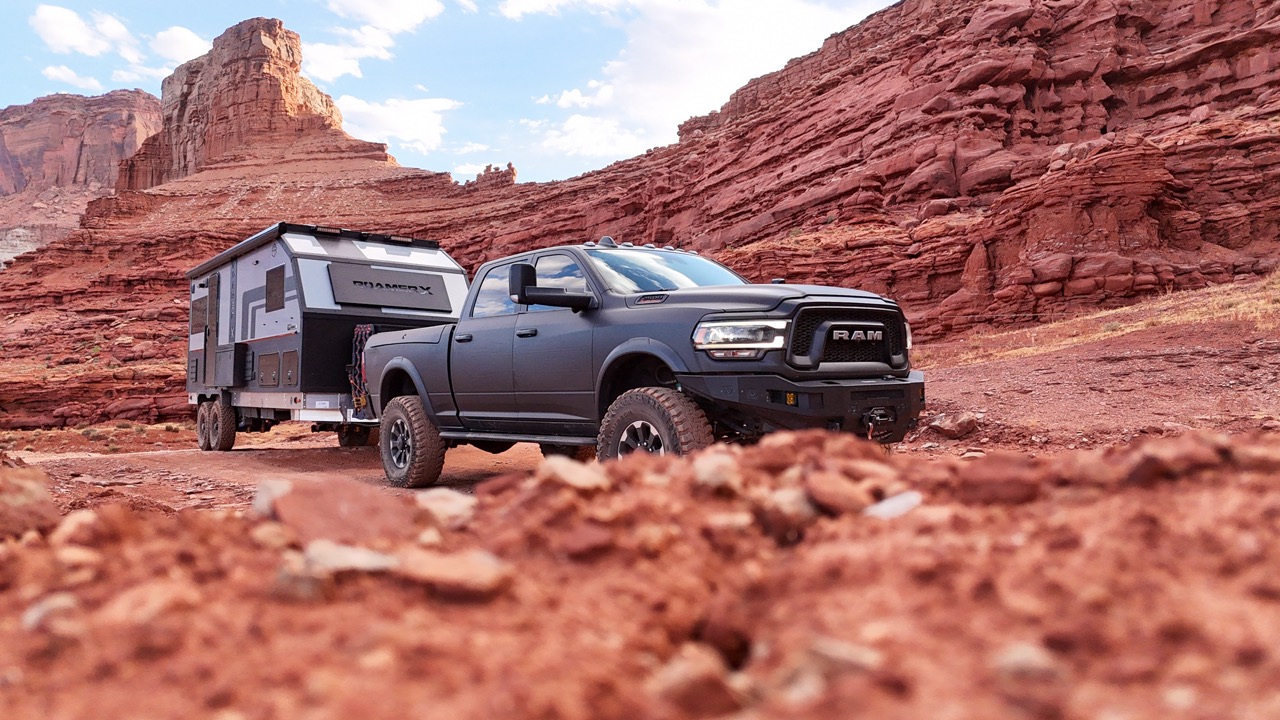
Picture the trip. Forty miles of dirt, washboard road that pushes the coffeecup off the dash, and a campsite at the end with nobody in sight. Some trailers love that road. Others rattle themselves apart on it.
The short answer. To tell if an off-road trailer is well built, check seven things. Full welds or tight, even rivet lines, with gussets (small steel braces) where the hitch and suspension meet the frame. A frame that is galvanized or aluminum. Each wheel moving on its own. A hitch that swivels in every direction. No wood in the walls. Someone who can tell you who set the bearings, the part each wheel spins on. And a warranty that does not exclude dirt roads. Every fail is a question for the builder. Three, and walk. The 15 point checklist at the bottom has the rest.
How long should one last? It depends. Our estimate with continued maintenance: 10 to 15 years for a standard trailer kept dry, 15 to 20 for mid tier, and 20 to 30 or more for a premium off-road build.
We have sold off-road trailers for years, so we have seen the other end of them: trade-ins that leaked long before they should have. We have also walked factory floors in Indiana and run these trailers on jeep trails in Moab to see what they can take. In our experience, most trailers that die on a trail were already in trouble when they left the factory, and the brochure never says how the bearings were set or what is inside the wall. Looking for answers to those questions led us to Pause and MDC. It is also why Pause builds our own ROAMER X. Every point below is something you can check on any trailer.
And more people need to check. Overland Expo’s 2025 industry report, covered by RV News, counts 8 million Americans who took an overlanding trip in 2024.
What does “off-road” actually mean on a trailer?
There is no standard definition. GoAuto reports that Australia’s consumer regulator has said so plainly, and we found no US standard either. Any maker can put bigger tires on a standard chassis and add a decal. One dealer listing for the Jayco Baja, for example, describes the off-road package as a flipped axle and all-terrain tires. Flipping the axle lifts the trailer a few inches. It changes nothing about the frame or the walls.
Capability and build quality are two different questions. Ground clearance, tire size and brake size tell you where the trailer can go. The frame, suspension, hitch, walls and fasteners tell you whether it will still be in one piece when it gets there. This post is about the second question.
A standard travel trailer has one job: carry its own weight down a smooth road. The most common build is wood ribs with a metal skin stapled on, which StressLess Camping calls “the least expensive way to build an RV.” Even highway trailers flex: in 2024 NHTSA opened an investigation into Grand Design Momentum and Solitude fifth wheels after complaints that frames flexed enough for entry doors to open while driving.
Washboard hammers a trailer for hours. Bolts work loose, latches pop, and a weak weld starts a crack that grows every mile. Ruts twist the frame like a towel when one wheel sits low and the other climbs a rock. Dust gets into any opening a moving trailer has, and water finds open seams and sits in the wall for months. A trailer built to take all that is over-built for pavement, which also makes it the better trailer at a campground.
Four checks you won’t find in the brochure
Frame, suspension, hitch and walls get their own sections below. These four get left out of most brochures. They come from owner forums, recall records, and trailers we have serviced or taken on trade, including a brand we stopped carrying when the quality slipped as the volume rose.
- The tires and wheels cannot carry the loaded trailer. Find the weight sticker near the door (the GVWR, the most the loaded trailer may weigh) and the load rating on each tire’s sidewall. Add up the tires. The total should clearly beat the sticker. We have seen it sit barely above the empty weight, so a tank of water and a weekend of gear put the owner over it, and bent rims and blowouts followed.
- Nobody can say who set the bearings. We reached the point, with one brand, of pulling every wheel on every new unit before it went out to a Roamer. A bearing set dry, over greased, too tight or too loose burns up on the first long haul and takes the end of the axle with it. Ask to see a wheel pulled. Spin it. It should turn smooth and quiet with no wobble when you rock it top to bottom.
- Appliances installed against their own manual. A propane fridge needs a shield behind it and a vent on the roof to get rid of heat. Without them it quits cooling in hot weather, and in the worst case we saw in our own shop, caught fire. Open the fridge vent and look for the shield.
- Electrical shortcuts. Circuits with no fuse, so a bound-up step motor pulls more current than the wire can take and the wire becomes the heater. Breakers that pull out of the panel by hand, which we have seen on trade-ins. Ask for the wiring diagram. A maker that calls it proprietary cannot show you the fusing either.
Welded vs riveted trailer frames: engineered for twist, protected from rust
What a good off-road trailer frame is made of
A good frame is designed by an engineer for the twist it will see, then protected from rust. GoRV puts engineering ahead of the amount of steel, and RV Daily lists a galvanized chassis and drawbar among its ten checks. Galvanizing is not paint. Zinc corrodes first, so the steel under it stays sound, and it coats the edges and corners where paint pulls thin. You can tell it by eye: dull, slightly mottled grey metal, not a glossy coat. The American Galvanizers Association’s coating life chart measures time to first maintenance in decades, which is not the same as service life but is a long way past the first chip in a painted frame.
Heavy does not mean strong, what’s more important is what it is made of.
Galvanized steel vs riveted aluminum
The two brands we carry solved the frame two different ways. We got the MDC details from its founder, who walked us through an XT19HRT, and the Pause details from Morryde, the Elkhart, Indiana company that engineers the frame.
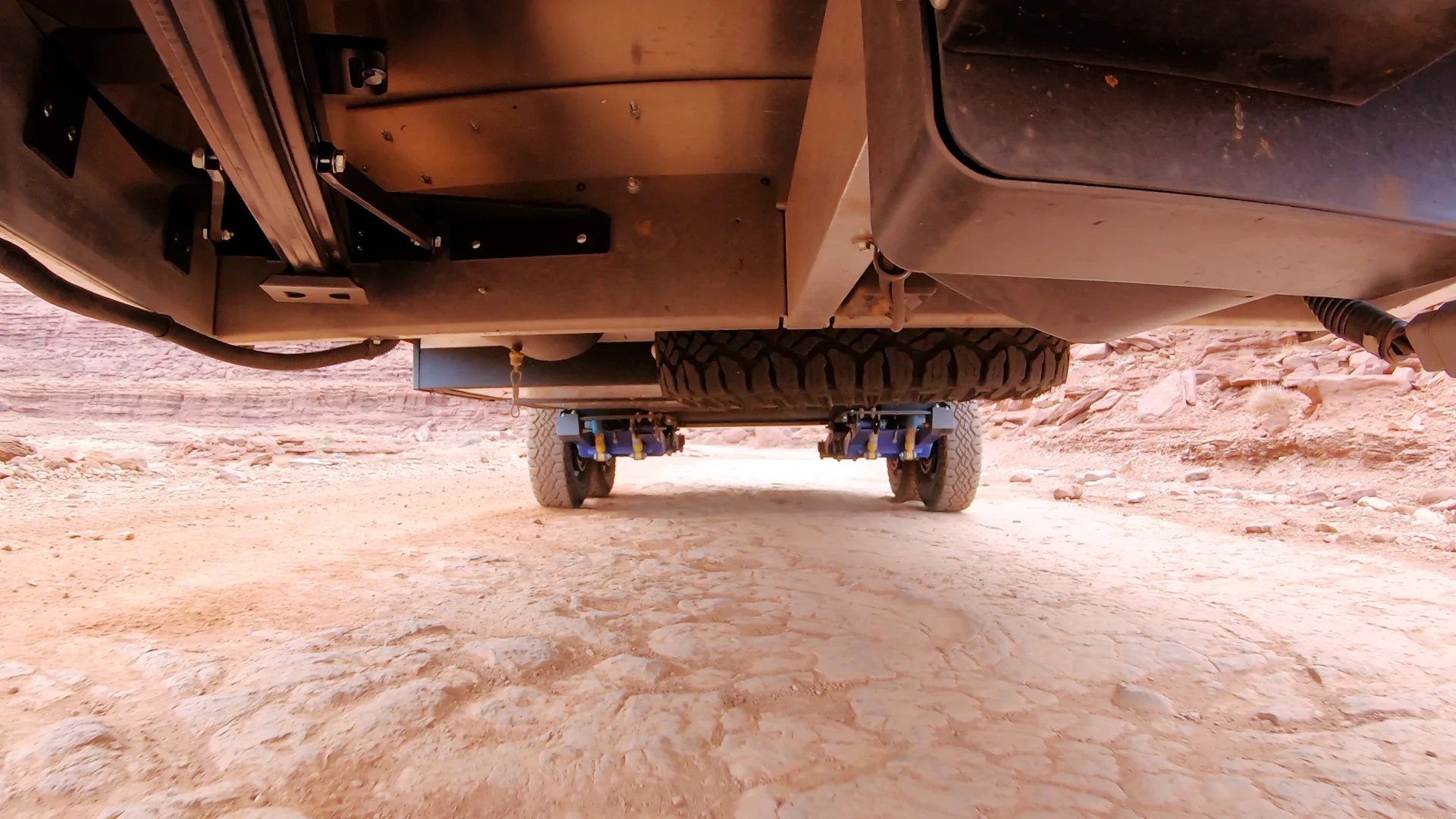
MDC welds high-strength steel and hot-dip galvanizes the A-frame. The bolts, nuts and washers are grade 8.8, a strength rating stamped on the bolt head, so look for 8.8 or higher. Every fastener is tightened to a set value and then marked with a paint stripe, so anyone can see if it has turned. The spare tire carrier, a part that snaps on a lot of trailers, is gusseted at the stress points. MDC’s founder called gussets trailer building 101. MDC backs the frame and chassis with a lifetime structural warranty.
Pause does not weld the frame at all. A shaped aluminum beam is joined with Huck rivets, the aircraft-style fasteners on tractor trailers that clamp tight and cannot back out like a bolt, plus industrial adhesive that spreads the load along the joint. Morryde’s reasoning: a weld is rigid, and a frame that twists over and over can eventually crack one. A riveted joint allows a small, controlled flex where the engineers want it. Where steel meets aluminum, a tape between the metals keeps them from corroding against each other.
Here is how the three common frame builds compare.
| Frame type | Galvanized welded steel | Riveted aluminum | Painted or powder coated steel |
|---|---|---|---|
| Rust | Zinc protects the steel, edges included | Aluminum does not rust | Protected until the coating chips |
| Twist | Stiff welds; depends on weld quality | Rivets allow controlled flex | Depends on weld quality |
| What to check | Even zinc, full welds, gussets at corners | Even rivet lines, steel isolated from aluminum | Chips, rust at welds and edges |
Welded versus riveted matters less than whether it was done well. The one that fails is the tack weld on a painted frame. Get down with a flashlight and look where the suspension mounts, where the hitch meets the frame, and where cross members meet the rails. A full weld is one continuous bead the length of the joint, the same width all the way. A tack weld is a few short dots with bare metal between them. Pinholes, a bead that stops short, or cracked paint at the ends of a weld are the warning signs. If the welds look different from front to back, the factory was not paying attention.
Off-road trailer suspension: each wheel on its own
What good off-road trailer suspension does
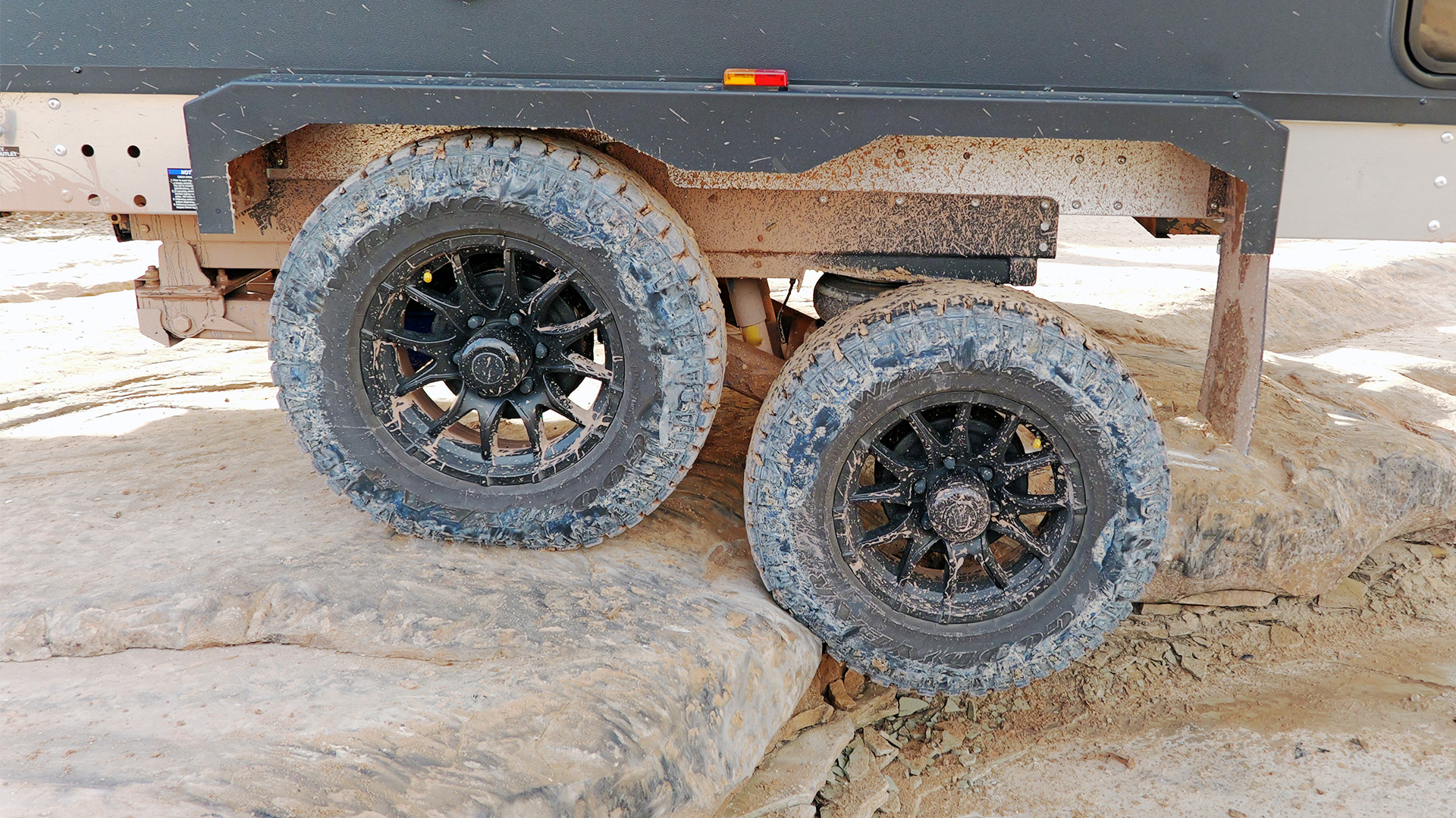
With independent suspension, one wheel can climb a rock while the other stays planted. The trailer stays level and the frame twists less. Overland Journal’s trailer test, rates independent long-travel suspension with shocks as ideal. An axle-less system like Timbren (a rubber spring on each wheel, no solid axle across) is the minimum. A torsion axle (rubber inside the axle tube, almost no travel) punishes the trailer on rough ground, in Overland Journal’s view. Leaf springs under a solid axle wear faster than torsion axles, per NAPA. A trailing arm is a hinged arm that lets each wheel swing up and down on its own, with a coil spring or an airbag and a shock.
This table shows how the four common systems compare on rough roads.
| Axle type | Leaf spring, solid axle | Torsion axle | Axle-less (Timbren) | Trailing arm, coil or air |
|---|---|---|---|---|
| Rough roads | Both wheels react together | Little travel | Each wheel on its own | Most travel; stays level on ruts |
| Wear and repair | Wears faster than torsion; easy fix | Not repairable when worn | Rubber ages | Bushings, shocks, airbags serviceable |
| Can be aligned (so tires wear evenly) | No | No | Usually not | On the better systems, yes |
Air suspension and trailing arms on Pause and MDC
Trailer air suspension on the Pause AR models comes from Morryde with about 12 inches of travel, Morryde says, which means a wheel can drop a full foot into a rut before the body follows. The airbags and fittings are the same ones semi trucks use. If the compressor fails, hand fill valves and rubber stops get you to camp. We compared air and axle-less in air versus Timbren.
MDC says it builds its own trailing arm suspension with bigger shocks that hold more oil and run cooler, because heat is what kills a shock on a long stretch of washboard. Both the Pause and the MDC suspensions can be aligned, per Morryde and MDC. Many cannot. If the wheels drift on rough roads and there is nothing to adjust, you eat tires. Ask any maker to show you the alignment procedure.
The articulating off-road hitch: let the trailer move on its own
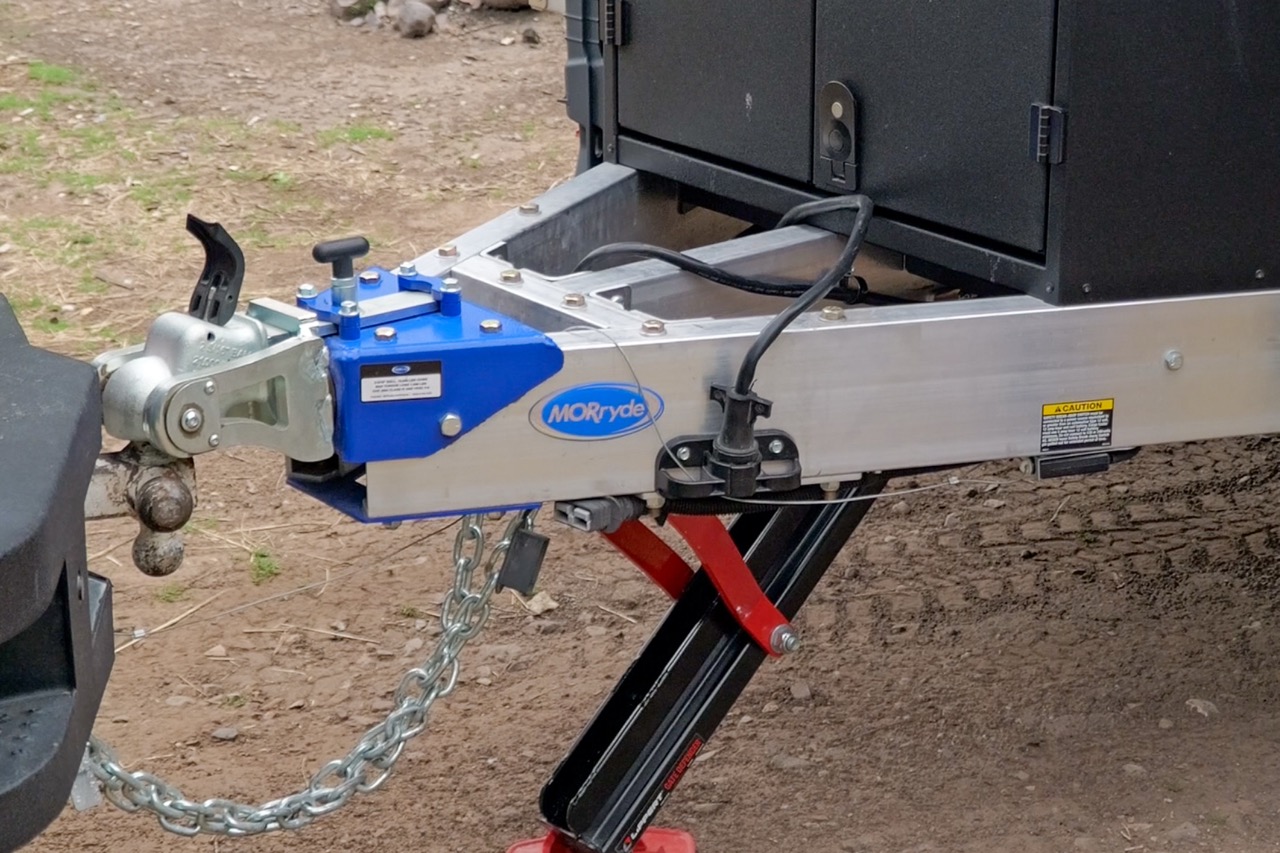
A standard ball hitch binds when the angle gets steep, near 22 degrees per GoRV. Several brands list couplings with a full 360 degrees of movement, so the trailer can roll, pitch and turn behind the truck without binding. Off Grid Trailers lists a Max Coupler, and Black Series and Opus fit one per RV Geeks and Trailer Life. MDC fits the Cruisemaster DO35 or DO45 depending on the unit, which, self-aligns within reason when you hook up and shows a cap only when it is locked, so you can see at a glance that it is latched. Pause uses a fully articulating hitch that Morryde developed for its trailers. It moves in every direction, unlike the standard ball above, and we have run it on jeep trails in Moab. Our view: a trailer without an articulating hitch is not really an off-road trailer.
Walls and roof: no wood, no leaks, no delamination
No wood in the walls
Water does the quiet damage. It gets into a wall, the wood layer soaks it up, and the skin lets go. That is trailer delamination, the bubbles on the sides of older RVs. RV Life names unsealed seams as the most common cause and notes the repair is rarely covered by insurance. Oliver’s double-hull fiberglass, Bruder’s composite body and Off Grid Trailers’ aluminum over foam are all listed with no wood in the wall.
How Pause and MDC build walls that last
No wood is where it starts. Whether the wall is still flat in year ten comes down to the glue and the seams, and those are the questions to ask any builder.
Pause walls come from County Line Laminating in Indiana, and we toured the line. The frame inside the wall is welded aluminum, and a half inch of dense foam sits between that frame and the outer skin so the two never touch, which provides excellent insulation. Skip that layer and you can see every stud on the outside of the trailer on a dewy morning. The backing is Azdel, a composite board that cannot soak up water the way wood does. The layers are glued in a vacuum bag so the adhesive grips deep into the foam, and County Line pull tests samples: the foam should tear before the glue line lets go. On top, a sticky waterproof tape over every seam, and solar panels on rails instead of screwed into the roof.
MDC has almost no seams. Its founder showed us that each side wall of the XT19HRT is one composite panel the full 19 feet, so there is no joint every few feet for water or dust to find.
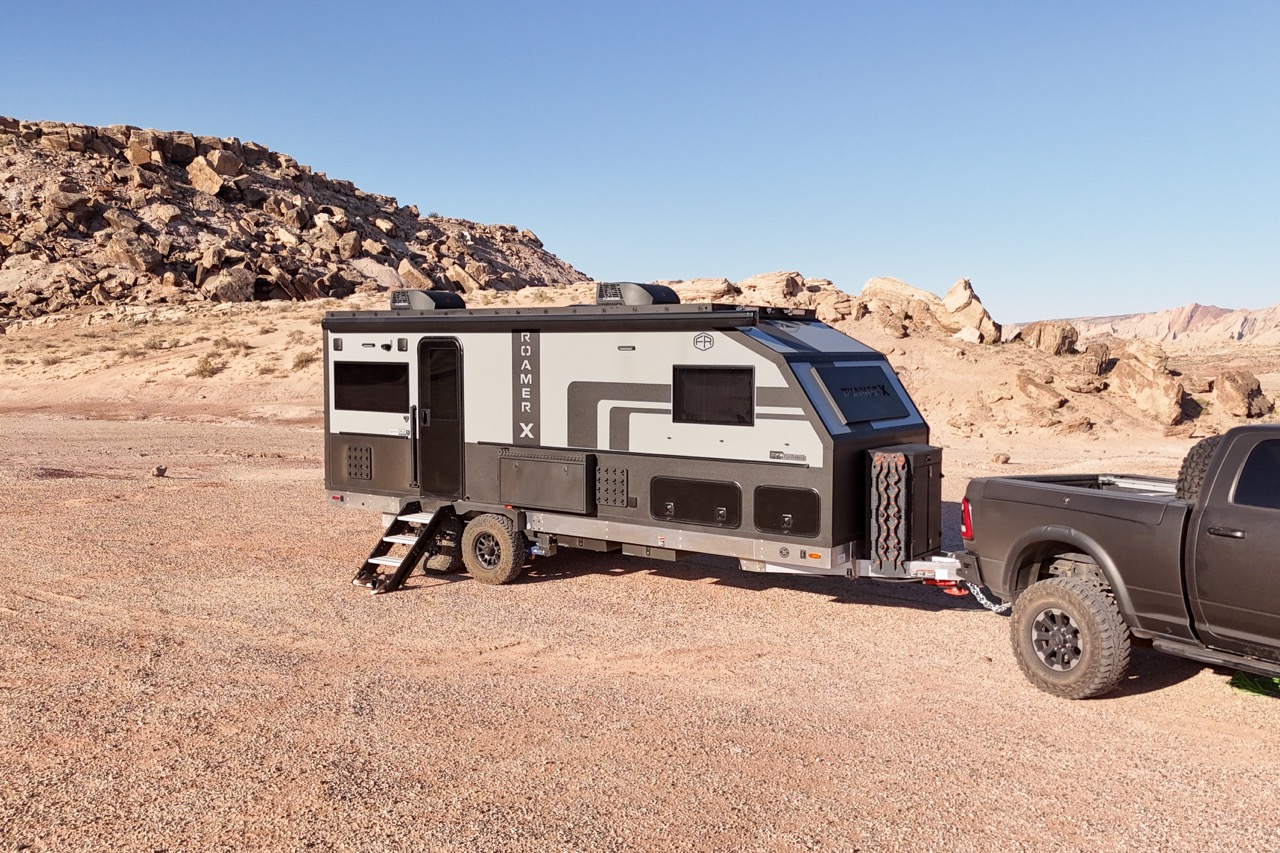
The ROAMER X, our own trailer, is built by Pause on the same line as the XC22.4 with the same walls, roof, floor and aluminum cabinets.
Dust seals, fasteners and the small parts of a well built off-road trailer
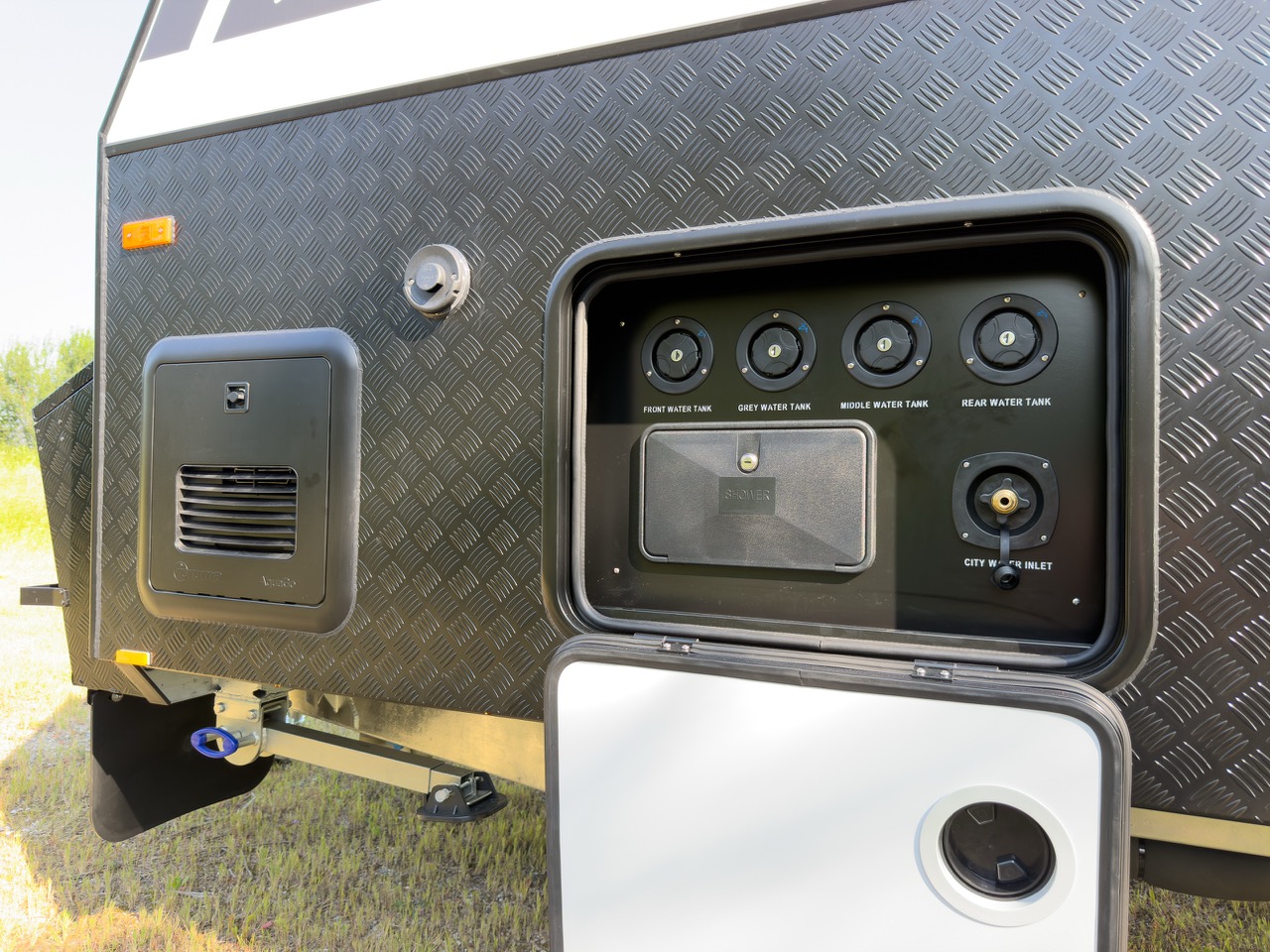
Seals. ExplorOz asks for automotive rubber seals on every door and hatch. MDC’s compartment doors use three of them and a cam lock that squeezes the seals as it turns. We left an XT19HRT dirty after nine days off grid and opened the kitchen on camera. Dust outside the seal. Clean inside.
Plumbing and gas. Brass fittings on the water lines instead of plastic, because brass does not crack the way plastic does. Look under the sink. Braided stainless propane lines do not rot in the heat or chafe through on washboard the way rubber does.
Fasteners. Anything that can unscrew itself on washboard will. Look for bolts with locknuts, the kind that cannot spin loose, instead of self-tapping screws, which cut their own thread and loosen under vibration. Look for shackle pins bent over so they cannot back out. If a trailer has recovery points, the tow hooks you pull a stuck rig out by, ask what they are rated for. When we asked Morryde’s engineers, they would not call something a recovery point without knowing the load and the angle of the pull.
Breakaway. The breakaway switch is the cable that applies the trailer brakes if it ever leaves your truck. In 2021 Black Series recalled up to 412 trailers because, if the breakaway pin was pulled and not put back, its battery could drain the main battery and overload the system. NHTSA recall 21V116 records it as a fire risk. With permission, pull the pin and confirm the brakes lock.
The tests, and what each one proves
Brochures love badges, and few of them say anything about the frame. Here is what each one covers.
| Test or badge | What it proves |
|---|---|
| RVIA seal | Gas, electrical, plumbing and fire safety built to code, with unannounced spot checks |
| NATM (National Association of Trailer Manufacturers) verification | Checked every two years on federal basics like lights, tires and labels |
| Computer stress modeling (FEA) | Engineers modeled where stress goes |
| Proving ground run | Frame and suspension survived a test track built to abuse vehicles |
| Salt spray test | Which coating resists corrosion better |
| Wall pull test | The glue bond is stronger than the foam |
| Load range E tires | A heavier-duty tire; the letter is on the sidewall |
Sources: RVIA, NATM, ChemQuest on salt spray.
We checked the websites and published reviews of about twenty off-road brands for this guide, and among them we found none that publishes durability test results. Morryde’s engineers told us during development they ran the Pause frame and suspension at the Navistar military proving grounds. They saw a small loss of wheel tilt on two corners, added a cross beam and plates, and ran it again until it didn’t fail. A manufacture who can tell you what the test broke has run one.
Which tier do you need, and how long should it last?
Not everyone needs the most capable trailer on the market. If your trips are campgrounds and graded gravel, a standard trailer may be exactly right. The trouble starts when a trailer is sold for trips it was never built to take. Rows come from what each brand lists or what we saw on tours, and not every brand in a column has every item.
| Standard trailer sold as “off-road” | Mid tier off-road | Premium off-road | |
|---|---|---|---|
| Good for | Paved and graded roads | Forest roads, regular rough stretches | Washboard, ruts, days from pavement |
| Estimated service life (our estimate, with normal upkeep) | 10 to 15 if kept dry; under 10 if the walls leak | 15 to 20 if kept sealed | 20 to 30 or more if kept sealed |
| What usually ends it | Water in the walls or floor | Seals, bushings, coating wear | Appliances and interior, long before the structure |
| Frame | Often standard steel, painted, axle flipped for lift | Galvanized or powder coated (paint baked on) steel, where listed | Welded steel or riveted aluminum, galvanized where listed |
| Suspension | Leaf spring or torsion | Timbren or trailing arm coil, where listed | Trailing arm coil or air; up to 12 inches of travel where the maker lists it |
| Hitch | Often a standard ball | Articulating, where listed | Articulating, where listed |
| Walls | Often wood framed or luan (thin plywood) backed; check | Aluminum or composite, no wood | Composite, no wood |
| Examples (per the listings and reviews linked in this guide) | Jayco Baja, Coachmen Clipper ROK | Black Series, Opus, Off Grid Trailers | Bruder, Pause, MDC, ROAMER X |
Oliver and Bowlus are premium builds too, fiberglass and riveted aluminum, but on conventional axles per their listings, so they sit outside the off-road tiers. We carry Pause and MDC, and Pause builds the ROAMER X; they are the builds whose makers answered every question on this page in person, at the factory, and that is why we carry them. Premium costs more, and most of what you pay for is out of sight, in the welds, seams and fittings. If that is a stretch, buy used. A pre-owned trailer built for rough roads beats a new one built for pavement, and the checklist below works on used trailers. One caution: MDC’s frame and chassis warranty and Oliver’s body and chassis warranty go to the original purchaser only, per each maker’s terms, so a used one carries the build, not the paper. See also the best built premium travel trailers in America if you want more details.
The service life row is our estimate. We could find no industry body or insurer that publishes a lifespan for towable RVs by construction type, so we worked it out from warranties, materials and what comes back on trade. Warranties give a rough floor. Keystone and Bowlus give three years on structure and three years. Grand Design gives five on the frame and Oliver five on body and chassis. MDC gives a lifetime on the frame and chassis. Wood rots once water reaches it, and owner threads on the Forest River forums describe luan walls delaminating within years. Galvanized steel goes decades before first maintenance. Aluminum does not rust and fiberglass does not rot, though both still need sealed seams. What comes back on trade tells the same story. In what we have taken on trade, wood-framed trailers often come back with water damage well before their time. Galvanized and composite trailers come back with worn tires and faded decals on a frame and walls that are still square. A higher tier gives you more margin to start with. It does not replace upkeep.
How do you keep an off-road trailer built to last?
Water, mostly. A 2021 NRVIA inspector survey, reported by RV News, found major issues in 35 percent of inspections. We would start at the roof. Check every seam each season and reseal before it leaks, not after. Have the bearings serviced on the schedule in the manual. Re-torque wheel nuts and suspension bolts after the first rough trip and periodically after that. MDC’s manual, has two tips worth copying on any off-road trailer. Touch up stone chips on a galvanized chassis with a zinc-rich coating. On long corrugated stretches, stop and let the shocks cool before they fade.
How to tell if an off-road trailer is well built: the 15 point walk-around checklist
Use this list on any trailer, new or used. A well built one passes nearly all of it, and every fail is a question for the builder.
- Underneath, with a flashlight. Pass: full welds or tight, even rivet lines, gussets at the suspension mounts, hitch and corners. Fail: tack welds, rust at welds or edges.
- Frame coating. Pass: galvanized (dull mottled grey) or aluminum. Fail: paint or powder coat with chips and rust.
- Suspension. Pass: each wheel moves on its own, real travel, and the seller can show you how it is aligned. Fail: a solid axle on leaf springs sold as off-road.
- Bearings. Ask who set them and when. Pass: the wheel spins smooth and quiet with no wobble when you rock it. Fail: nobody knows when it was set.
- Hitch. Pass: it swivels in every direction. Fail: a fixed ball that cannot articulate.
- Tires and wheels. Pass: the tires’ combined load rating clearly beats the GVWR sticker. Fail: barely above, or below GVWR.
- Bolts. Pass: paint marks across bolt heads, locknuts on the straps that hold the tanks and on plates. Fail: self-tapping screws into the frame.
- Recovery points and chains. Pass: a rated number in pounds and who tested it, and safety chains with rated hooks. Fail: “they are fine.”
- Walls. Look down the side in low light. Pass: flat. Fail: waves or stud lines. Ask what is behind the skin: luan or a composite.
- Roof. Pass: few holes, each sealed with sealant made for RV roofs. Fail: vents bedded in a smear of poorly applied sealing or caulk.
- Seams. Run a finger along the trim. Pass: sealed both sides. Fail: just pressed in.
- Compartments and seals. Open one. Pass: dry and dust free, rubber seals, a latch that presses them. Fail: dust or water inside, a single latch.
- Fridge vent, if it has a propane fridge. Pass: a shield behind the fridge and a vent on the roof. Fail: an open cavity.
- Plumbing and gas. Pass: brass fittings under the sink, braided gas lines. Fail: plastic and rubber.
- Electrical and breakaway. Pass: wires sleeved and grommeted, every circuit fused, breakers that stay put, and with permission, the breakaway pin pulled and the brakes lock. Fail: anything loose or unfused, or a breakaway that does nothing.
Then the paperwork. How long is the structural warranty, and does a dirt road void it? GoAuto found Australian off-road warranties that exclude rutted tracks, and Keystone’s structural warranty applies only to “recreational camping,” so read the exclusions first. Is there a full manual and wiring diagram? MDC’s, runs up to 100 pages, which means a shop a thousand miles from the factory can service it.
Off-Road Trailer Build Quality: Common Questions
How long does an off-road trailer last?
We found no published industry figure. Our estimate comes from warranty terms, how the materials age and what we see on trade-ins. Standard trailer kept dry, 10 to 15 years. Mid tier, 15 to 20. Premium off-road build, 20 to 30 or more. Normal upkeep means yearly seam checks and bearing service.
Is a heavier trailer better built?
Not by itself. Weight can come from strong materials or from cheap heavy ones, so ask what it is made of, and look at the welds before you trust the scale.
Is an aluminum or steel trailer frame better for off-road?
Neither by default. A well made galvanized steel weld and a well made riveted aluminum joint both last. Aluminum does not rust; galvanized steel protects its edges. Look for full welds and gussets on steel, even rivet lines on aluminum, and walk away from a tack weld on a painted frame.
Is independent suspension better off-road?
Yes, if the shocks and springs match the loaded weight. When one wheel climbs a rock the other stays on the ground, so the trailer stays level and the frame twists less. Ask how much travel it has and whether it can be aligned.
Can you tell build quality from the outside?
Some of it. Wavy walls, stud lines on a dewy morning, sloppy sealant and single latches all show from the outside. The rest is underneath, which is why the checklist starts with a flashlight.
See it for yourself
You cannot judge a trailer from a photo, come to any of our four Experience Centers, in Lindon, Utah; Mesa, Arizona; Colorado Springs, Colorado; and Duncan, South Carolina. Pull on the latches. Look under it. We will show you the answers on our trailers and tell you what to look for on anyone else’s. We want more families out in nature with the trailer the last thing on their mind.